• Skip to primary navigation
  • Skip to main content
  • Skip to primary sidebar
  • Skip to footer
HeLT Consulting

HeLT Consulting

  • Home
  • How We’re Unique
    • Our C.O.R.E.E. Brand Approach
    • We Get Tactical
    • Why Brand
    • How We Build Your Brand
    • HeLT in the News
  • Services
    • Packages
    • Branding & Positioning
    • Market Research
    • On-Brand Marketing Projects / Campaigns
      • Publisher Branding
      • Author Branding
      • Small Business Branding & Marketing
  • Portfolio
  • Blog
  • About
    • About HeLT Consulting
    • Our Team
    • Testimonials
  • Contact

brand values

Benefits of a Strong Brand, Part 4 – Better Representation from Employees and Those Who Support You

October 1, 2013 by Heidi L. Toboni

Here’s one more recent client story in this blog series that demonstrates why committing to a strong brand with clearly defined brand values yields a great return on your investment:

Benefits of a Strong Brand - Strong Links in the Chain - Brand Specialist Blog ImageI attended a recent meeting at one of our branding clients where I happily observed firsthand some great on-brand decision making by their staff.  This client—a fast-growing and highly respected consulting firm—had gathered its consultants to participate in a round of debriefing and brainstorming about ways to handle difficult situations that arose with their clientele. A team member brought up a situation that had arisen with their customer Costco, in which someone on the Costco team had proposed an exception to my client’s proven consulting process by introducing a second level of variables and decision making for the sake of “flexibility.” The team member of my client was asking the group at the meeting how to handle this and similar situations in the future.

At this point, one of my client’s more senior consultants spoke up and—to my great joy—said without prompting, “No, I don’t think allowing that exception is on-brand for us.” The consultant went on to point out specifically how the proposed exception overcomplicates my client’s process and could lead to delays and confusion down the line. This was a critical catch on the senior consultant’s part, since the exception had direct bearing on two of the company’s brand values [attributes they promise their clients they will represent]: Clarity/Demystification and Quickness. Allowing this or similar exceptions to creep into my client’s process would have significantly decreased the clarity and speed that their customers experienced.  It would have gone against my client’s value proposition, negatively affected their brand, and reduced the unique competitive advantage that they were becoming so known for in the marketplace.

SUMMARY: This story is a fantastic example of the benefits of branding.  You know you have a strong brand when others in your organization are actively safeguarding the competitive values you provide to clients/customers and when they “tell” you what your brand is through their own words and actions.  Best of all, in a well branded organization this is happening organically every day.

Facebooktwitterlinkedininstagramflickrfoursquaremail
Facebooktwitterredditpinterestlinkedinmail

Filed Under: Benefits of Branding, Client Results Tagged With: benefits of a strong brand, blog series, brand attributes, brand values, brand-building, brand-building in practice, client results, employees, on-brand decision making, why branding matters

Benefits of a Strong Brand, Part 2 – Greater Collaborative & Strategic Partnership Opportunities

August 1, 2013 by Heidi L. Toboni

Do you know what a great sign of a really strong brand is? When others in the marketplace tell the story of your brand for you. Here’s another fun client anecdote that illustrates a second important advantage of having a powerful, clear brand:

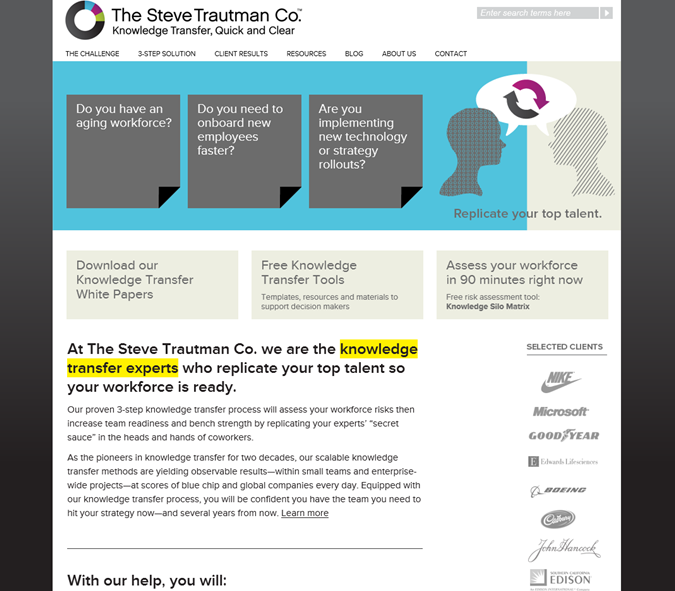
Benefits of a Strong Brand - The Steve Trauman Co. -Brand Specialist Blog ImageI recently was asked to attend a company meeting of one my rock star clients, The Steve Trautman Co. (STC). This Seattle-based consulting firm is today’s leading expert in knowledge transfer and serves a blue-chip client list—such as Boeing, Nike, Microsoft, Goodyear, U.S. Steel, Aetna and more—with global solutions in knowledge transfer. HeLT had led STC through a rebranding just over three years ago and has since served as their brand manager. The gathering I attended included the company’s employees and contractors, plus a new strategic partner whom I hadn’t met. This new partner—Kathy Hagen of K L Hagen Intellectual Capital Strategies—would soon begin helping STC with some account management and sales. The interesting thing is that Kathy is, by all extents, a Steve Trautman competitor. She runs one of the few successful businesses that specialize in the same field (knowledge transfer) and targets a Fortune 100 to 500 client list as Steve’s firm does. Also like Steve, she has been doing this work for decades and positions herself as a thought leader.

A few minutes into the meeting while introductions were being made, Kathy addressed this issue directly. To my surprise, she started off by looking at me and saying, “I want to thank you. Without your branding work, I wouldn’t be here.  It is because of Steve’s brand that I am able to be here.” 

This new strategic partner went on to explain that because the STC brand was presented so clearly in the marketplace, and because she could perceive how Steve Trautman had positioned his firm to clients, she could understand without much effort how her own offerings to clients differed in value from STC’s. There is some overlap, she admitted, but it was not enough to cause her to walk away from a strategic partnership opportunity when Steve initially reached out to her.  “I could tell there was enough difference in our actual knowledge transfer processes and in the way our two companies market ourselves that I was willing to take Steve’s call and explore options.” 

I was so overjoyed when I hear this at the meeting, I just knew I had to blog about it. It meant we had all played our role developing and representing the brand well. Now, instead of competing against each other, two these thought leaders are collaborating. In some cases, Kathy is recommending people in her network to STC for what Steve’s company can provide (STC’s service is quicker, includes a risk assessment framework, and is more scalable enterprise-wide); STC is recommending their clients to Kathy when those organizations  want to go deeper (her business works more one-on-one and delves further into tacit knowledge). Kathy said at the meeting that without the clear brand apparent in all STC does, she would not have felt comfortable entering into this strategic partnership.

SUMMARY: Having a focused, strong brand enables an organization to more easily find and collaborate with strategic partners.   By clearly communicating to the marketplace what values you stand for and compete on, you are not limiting your opportunities for partnership—as some incorrectly assume.  You are signaling where, with certain parameters, common ground can be found.

Facebooktwitterlinkedininstagramflickrfoursquaremail
Facebooktwitterredditpinterestlinkedinmail

Filed Under: Benefits of Branding, Client Results, Uncategorized Tagged With: benefits of a strong brand, blog series, brand attributes, brand positioning, brand values, client results, kathy hagen, strategic partnerships, the steve trautman co., why branding matters

Benefits of a Strong Brand, Part 1 – Increase Your Value to Your Target Clients/Customers

July 1, 2013 by Heidi L. Toboni

Here’s a quick client anecdote that illustrates an important benefit gained from a well-defined and strong brand:

Benefits of a Strong Brand - ProfessorsChoice.com - Brand Specialist Blog imageA few years back, HeLT worked with a publishing industry client who had started a new business unit that used state-of-the-art technology to produce custom textbooks for university professors.  Professors who could not find the course book they wanted could use the client’s service to design their own custom, hardcover, professional-looking textbook.  The client felt they had a pretty good idea of what their brand values would be before using our C.O.R.E.E. Brand Positioning Process: they knew choice and cost-savings were important values to their target customer.

The business unit already relied on a vast network of contracted partnerships with other publishers to access the copyrighted materials needed to produce the custom textbooks in their specific genre (religion).  As a result, my client could undeniably provide professors the greatest choice of content available in the marketplace at the time.  Technology advancements had also made automated print-on-demand books very cost effective to produce—so the client’s service was not only free to professors but also would result in a textbook that cost students (per page) the same or less than a standard textbook (which had material the professor didn’t intend to teach).

Through my branding process the client identified a third very important value they had overlooked: convenience. 

The business unit’s main competition was actually on-campus copy centers that for decades had produced customized, spiral-bound course packs—except professors themselves were responsible for gathering all copyright permissions before a copy center would print a single page.  The new business unit, having already obtained publisher permissions in return for % of proceeds, was the most convenient and time-saving option for busy professors.  After identifying this as a third brand value, the client began to emphasize it in both marketing and in the client’s enhancement of the service itself (e.g. creating simple “1 -2- 3” process explanations on the service’s website, adding more one-click options when building a book).  The client also began to promote that the new business unit was able to beat copy centers in quick and guaranteed shipping overseas when a professor was teaching a semester abroad (copy centers were notoriously slow and unreliable—definitely not convenient).

As a result of HeLT’s brand positioning process, the client’s staff produced time-saving measures and marketing that literally increased the attractiveness and value of its service to their customers—and sales grew.

SUMMARY: Great branding often reveals untapped opportunities where you can add real value to your client, customer, or reader offerings.  If you haven’t formally positioned your brand and defined your brand values, you are likely overlooking meaningful competitive advantages and leaving the chance to leverage these on the table.

Facebooktwitterlinkedininstagramflickrfoursquaremail
Facebooktwitterredditpinterestlinkedinmail

Filed Under: Benefits of Branding, Brand & Branding, Client Results, Uncategorized Tagged With: benefits of a strong brand, blog series, brand positioning, brand values, brand-building, c.o.r.e.e. brand positioning process, client results, on-brand marketing, Professor's Choice, unique competitive advantage

Rebooting an Iconic Brand: Oreo Cookies in China

December 16, 2012 by Heidi L. Toboni

Changing product attributes for perceived brand values - brand reboot - Oreo cookie[Repost from older blog. Original posting date: Sept. 23, 2008] The case of venerable American company Kraft Foods and their foray into the Chinese market with the top brand in their Nabisco cookie line—the iconic Oreo—is a great example of a crucial tenant of branding: your brand is unlitmately not yours—it’s the world’s.

The Oreo has long been the best-selling cookie in America (a Kraft claim that no one seems to be disputing). It’s now also the best-selling cookie in China—but this wasn’t always so for the tasty two-toned treat. When Kraft Foods first unveiled the cookie to the Chinese in 1996, and then up until 2005, sales were less than stellar. Into the picture came a Kraft veteran, 37-year-old Shawn Warren, who had spent years marketing and promoting the Nabisco brands around the world. Warren could see that change was needed. But what?

First, he listened to the marketplace seeking insight into why the Oreo wasn’t selling well, and learned that: a) the Chinese aren’t big cookie eaters to begin with; b) they thought the Oreo as we know it here in America was too sweet, and c) they found the price expensive for a quick snack. Also important, Warren noted two related trends: that the Chinese are increasing their taste for milk in their diet and that the cookie-wafer segment of the Chinese market was the fastest-growing, lead by Kraft’s rival Nestlé SA.

Armed with this customer insight, Warren guided Kraft to make a bold strategic move: change the iconic cookie to meet the needs of the target consumer. For the first time in its history, Kraft redesigned the Oreo for a foreign market. They developed and tested 20 prototypes of a new Oreo more suited to Chinese tastes and economic needs. They made a wafer-style treat that had four thin layers of the famous dark-and-light combo, was coated in chocolate, and less sweet. The Chinese packaging was redesigned to refer to the product as a “biscuit,” not a cookie, and less wafers were included per pack, allowing the price to be lowered. Then a grassroots marketing & promotion campaign commenced to educated Chinese snackers that the Oreo is traditionally paired with milk. The company introduced an Oreo apprenticeship program at 30 Chinese universities, which drew 6,000 applicants. Three hundred of the best were trained as Oreo brand ambassadors, who went around doing things like handing out the new treat on bicycles decorated with Oreo wheels, or at Oreo-themed basketball games that reinforced the idea of “dunking” in milk. All these tactics were decided at the local level. Today the Chinese version of the Oreo is the best-selling biscuit in the country and the company is planning to expand to different regions in Asia.

The point? That while your organization’s vision for its brand may not change (i.e. the company’s brand ideals & mission), the execution of your brand attributes, services to your customers, and—in particular—your products do change.  Especially the successful ones, because their growth causes them to forary into new markets and test the boundaries of their brand elasticity.

As company leaders and representatives of your brand, you should understand that you do not determine what your brand is. The marketplace does. A brand is not a marketing slogan or an ad campaign or corporate vision statement. A brand is the sum total of all the perceptions, beliefs, associations, assumptions, and feelings about your company or line of products by your customers, the marketplace, and the public-at-large. They ultimately determined what your brand is. Thus, your brand will change over time.

What you, the company, determine is your brand vision—what you ideally wish that sum total would add up to. Your company is on one end of this on-going conversation and the marketplace is on the other, and you should always be trying to lead the conversation toward that ideal vision for your brand. Sometimes this might mean changing iconic attributes of your product or brand identity that have now become what we at HeLT call off-brand in comparison your ideal.

Brand-building then becomes a back-forth dialog. The world will change the way you express your brand ideal via your products and services, either because you are proactively listening and responding to the consumer—like in the case of Orea cookie in China—or because you have passively allowed yourself to be branded right out of the competitive marketplace.

SUMMARY: Product developers, editors, producers, and executives should not be afraid to make informed changes to traditional attributes of your branded products—even your most successful ones. Brand attributes are often perceived differently in different markets and at unique times in the history of your brand. Change is warrented at times to draw customer perceptions back in line with your brand vision. And remember, sometimes these changes go down better with a little milk.

References: “Kraft Reformulates Oreo, Scores in China” by Julie Jargon, Wall Street Journal, 5/1/08

Facebooktwitterlinkedininstagramflickrfoursquaremail
Facebooktwitterredditpinterestlinkedinmail

Filed Under: Brand & Branding, Brand Refresh, Brand-Building Practices Tagged With: brand attributes, brand identity, brand reboot, brand values, brand vision, brand-building, definition of brand, iconic brand

Primary Sidebar

“What you focus on grows”

Sign up for our HeLT email updates. We promise not to flood your inbox. We will only send you periodic updates of important company news.

Sign Up

Footer

Benefits of a Strong Brand, Part 4 – Better Representation from Employees and Those Who Support You

Benefits of a Strong Brand, Part 4 – Better Representation from Employees and Those Who Support You

Learn More...

Benefits of a Strong Brand, Part 3 – Create Stronger, More Cost-Effective Marketing

Benefits of a Strong Brand, Part 3 – Create Stronger, More Cost-Effective Marketing

Learn More...

HeLT Consulting
© 2026 HeLT Consulting

2351 W River Loft Ct
Chicago, IL 60618
(773) 387-7416

Follow Us

  • LinkedIn
  • Twitter

Sitemap | Sitemap.xml
Website by AdeptPlus

"HeLT Consulting helped us take on the daunting task of rebranding our 17 year old consulting firm to reflect a new direction. Heidi Toboni has a clear and thorough process that kept my ego in check while she methodically uncovered and summarily shot all my sacred cows. No small task indeed."

—Steve Trautman
Founder & Principal of The Steve Trautman Co., global leaders in managing talent risk for Fortune 500s and 1000s

Copyright © 2026 · Genesis Sample on Genesis Framework · WordPress · Log in